
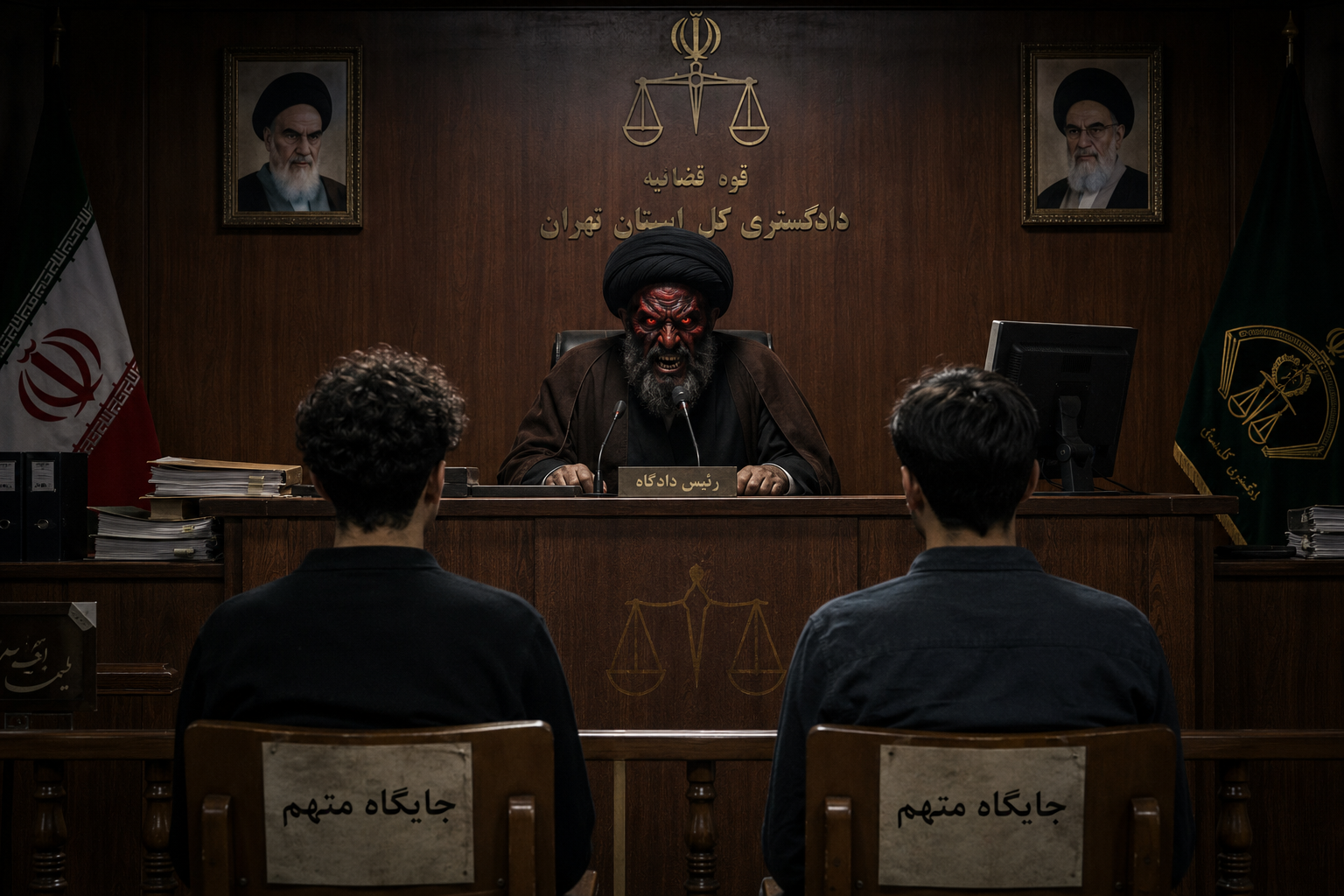
Iranian authorities have executed three men arrested during the January anti-government protests in Mashhad, amid growing warnings that the Islamic Republic is accelerating executions against protesters and political detainees.
Ebrahim Dolatabadinejad, Mehdi Rasouli and Mohammadreza Miri were executed at dawn on May 3, 2026.
Human-rights organizations say the executions were carried out after deeply disputed judicial proceedings marked by allegations of torture, forced confessions, lack of transparency and denial of basic fair-trial protections.
Their deaths became publicly known on May 4, when Iranian state media and several human-rights organizations confirmed the executions.
The three men had all been detained in connection with the January protests in Mashhad, but they did not face identical cases.
Mehdi Rasouli
Mehdi Rasouli was 25 years old and from Kashmar.
He had been arrested in connection with demonstrations in Mashhad and was prosecuted alongside Mohammadreza Miri over the death of a Basij member during the January unrest.
According to HRANA, investigators found a video on Rasouli’s mobile phone showing a Basij member being beaten during the protests.
Security authorities alleged that Rasouli was one of the people involved in the assault and that the security-force member later died from his injuries.
But according to a source familiar with the case, Rasouli told relatives that he had been subjected to severe physical and psychological torture and forced to accept responsibility for the killing.
The same source said the confession obtained during interrogation became a central part of the evidence used against him.
Human-rights organization Hengaw likewise reported that Rasouli and Miri were sentenced to death based on forced confessions obtained under torture. Hengaw (hengaw.net)
Rasouli reportedly made a brief telephone call to his family on May 2 after being transferred to solitary confinement in preparation for execution.
He was hanged the following morning.
According to Hengaw, he and Miri were executed without being granted a final family visit. Hengaw (hengaw.net)
Mohammadreza Miri
Mohammadreza Miri was 21 years old and from Mashhad.
He was a worker and was prosecuted in the same case as Rasouli.
Iranian judicial authorities accused the two young men of involvement in the killing of a Basij member during the January protests and publicly portrayed them as participants in violent unrest.
State-linked reporting also described them as connected to Israel’s Mossad intelligence service.
Those accusations came from the same judicial and security institutions responsible for their detention, interrogation and prosecution.
Human-rights groups have challenged the reliability of the proceedings and reported that both defendants were subjected to pressure and forced confessions. Hengaw (hengaw.net)
Miri was executed alongside Rasouli in Vakilabad Prison on May 3.
He was just 21.
The speed and secrecy surrounding the case leave serious unanswered questions about whether the evidence against him was ever independently tested in a genuinely fair judicial process.
Ebrahim Dolatabadinejad
The case of Ebrahim Dolatabadinejad was separate.
He had been arrested during the January protests around Mashhad’s Tabarsi Square.
According to Hengaw, a Revolutionary Court in Mashhad sentenced him to death on April 27, 2026 on charges including moharebeh — “waging war against God” — and “leading demonstrations.”
Only six days later, on May 3, his death sentence was carried out. Hengaw (hengaw.net)
Rights monitors say his proceedings lacked transparency and basic due-process guarantees.
Hengaw reported that no credible evidence establishing guilt was publicly presented and described the rapid sentencing and execution as a serious violation of internationally recognized fair-trial standards. Hengaw (hengaw.net)
Dolatabadinejad was also a father of two children, aged 9 and 14.
His family had already been deeply affected by the crackdown.
According to Hengaw, his brothers Vahid and Esmail were imprisoned, while his 14-year-old son Iman had also been detained during the protests before later being released from juvenile detention. Hengaw (hengaw.net)
Three Executions in a Single Morning
All three executions were carried out on May 3.
Iran Human Rights said the men had been arrested in connection with the January 8 and 9 protests in Mashhad and condemned their executions in the strongest terms. iranhr.net
By May 4, Hengaw had documented at least 13 executions of people detained during the January protests, while at least 30 protest detainees had reportedly received death sentences. Hengaw (hengaw.net)
That context makes these executions especially alarming.
They are not isolated events.
They are part of a rapidly expanding use of capital punishment against people detained during one of the most significant waves of anti-government unrest in Iran.
Forced Confessions Cannot Establish Justice
The Iranian authorities have the responsibility to investigate genuine crimes committed during protests.
But the severity of an accusation cannot justify torture, coerced confessions or denial of due process.
When a person faces execution, the standard of evidence and judicial fairness must be exceptionally high.
A confession obtained through physical or psychological abuse cannot be treated as reliable evidence.
A trial conducted without meaningful independent scrutiny cannot provide confidence that the truth has been established.
And an execution carried out only days after sentencing leaves almost no meaningful opportunity to challenge judicial errors.
The death penalty makes every failure in the justice system irreversible.
Families Were Reportedly Kept Silent
Another disturbing feature of the Rasouli and Miri cases is the treatment reportedly experienced by their families.
Rights organizations say relatives were pressured to remain silent after being led to believe that the sentences could potentially be reviewed or reduced.
Hengaw reported that authorities used promises of possible commutation to discourage public attention to the cases. Hengaw (hengaw.net)
If accurate, such conduct represents more than secrecy.
It means families may have been encouraged to believe there was still hope while preparations for execution were already underway.
No family should learn that assurances of possible clemency were followed instead by the execution of their child.
The Islamic Republic Must Be Condemned
The executions of Ebrahim Dolatabadinejad, Mehdi Rasouli and Mohammadreza Miri deserve unequivocal condemnation.
The Islamic Republic cannot claim justice while defendants face credible allegations of torture and coerced confessions.
It cannot claim due process while capital cases proceed through opaque Revolutionary Courts and sentences are carried out at extraordinary speed.
And it cannot extinguish political opposition by putting protesters on the gallows.
Executions may create fear.
They do not create legitimacy.
Iranians Have the Right to Demand Fundamental Political Change
People in Iran have the right to protest peacefully against the government.
They have the right to reject the Islamic Republic and advocate for a fundamentally different political system.
They have the right to organize for democracy, secular government, constitutional change or any other political alternative they freely choose.
And they have the right to determine Iran’s political future without being imprisoned, tortured or executed for challenging those in power.
Those rights do not disappear because the government labels dissent a security threat.
The future of Iran must ultimately be determined by its people through free political participation and without state violence.
The executions carried out on May 3 should therefore not be treated merely as another entry in Iran’s execution statistics.
Behind those numbers were three human beings.
Mehdi Rasouli was 25.
Mohammadreza Miri was 21.
Ebrahim Dolatabadinejad was a father of two.
They were arrested during a moment of nationwide political unrest and were dead only months later.
Their cases should increase international scrutiny of Iran’s execution system and strengthen demands for an immediate halt to all protest-related death sentences.
Silence will only make further executions easier.
Sources
https://www.en-hrana.org/january-protests-mehdi-rasouli-and-mohammadreza-miri-executed/
https://hengaw.net/en/news/2026/05/article-17
https://hengaw.net/en/news/2026/05/article-16
Leave a Reply